
Three things to know first
- Where it is used depends on your goals. Rib cartilage can support the tip or augment the bridge and nasal base as needed.
- The approach also depends on your nose. Dr. Hane also uses the closed approach for operations involving rib cartilage.
- Not everyone needs rib cartilage. Another option may be suitable.
Rhinoplasty Cases Using Rib Cartilage
Rib cartilage may be considered when more tip height or support is desired, or when your own tissue is preferred for the bridge.
- Change tip height or direction
- Use your own cartilage for the bridge
- Discuss shape after previous surgery
Goals alone do not determine suitability. Examination assesses nasal anatomy and the amount and support needed. These photos show combined procedures; the same outcome is not guaranteed.
Case 1 | More height for the tip and bridge
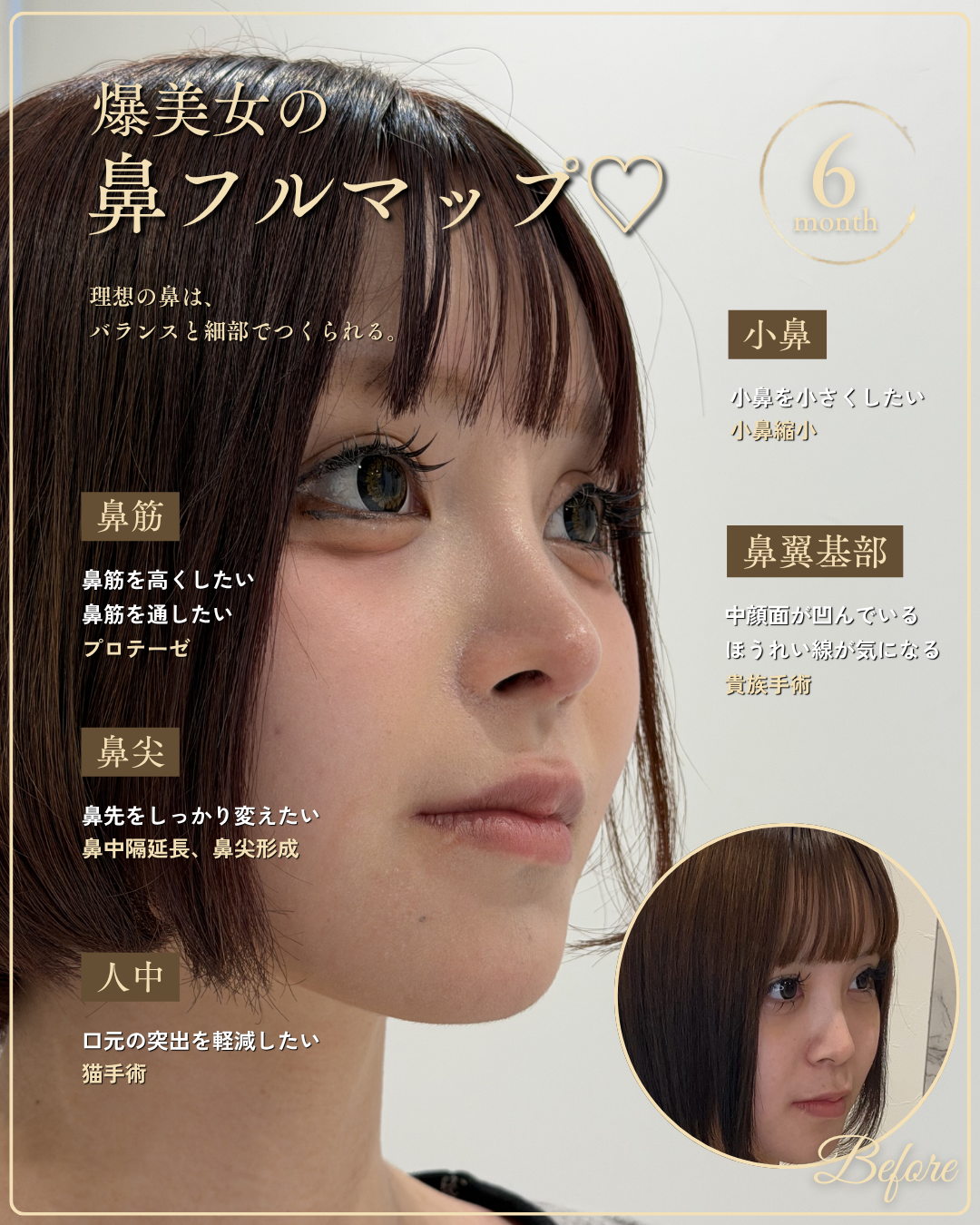
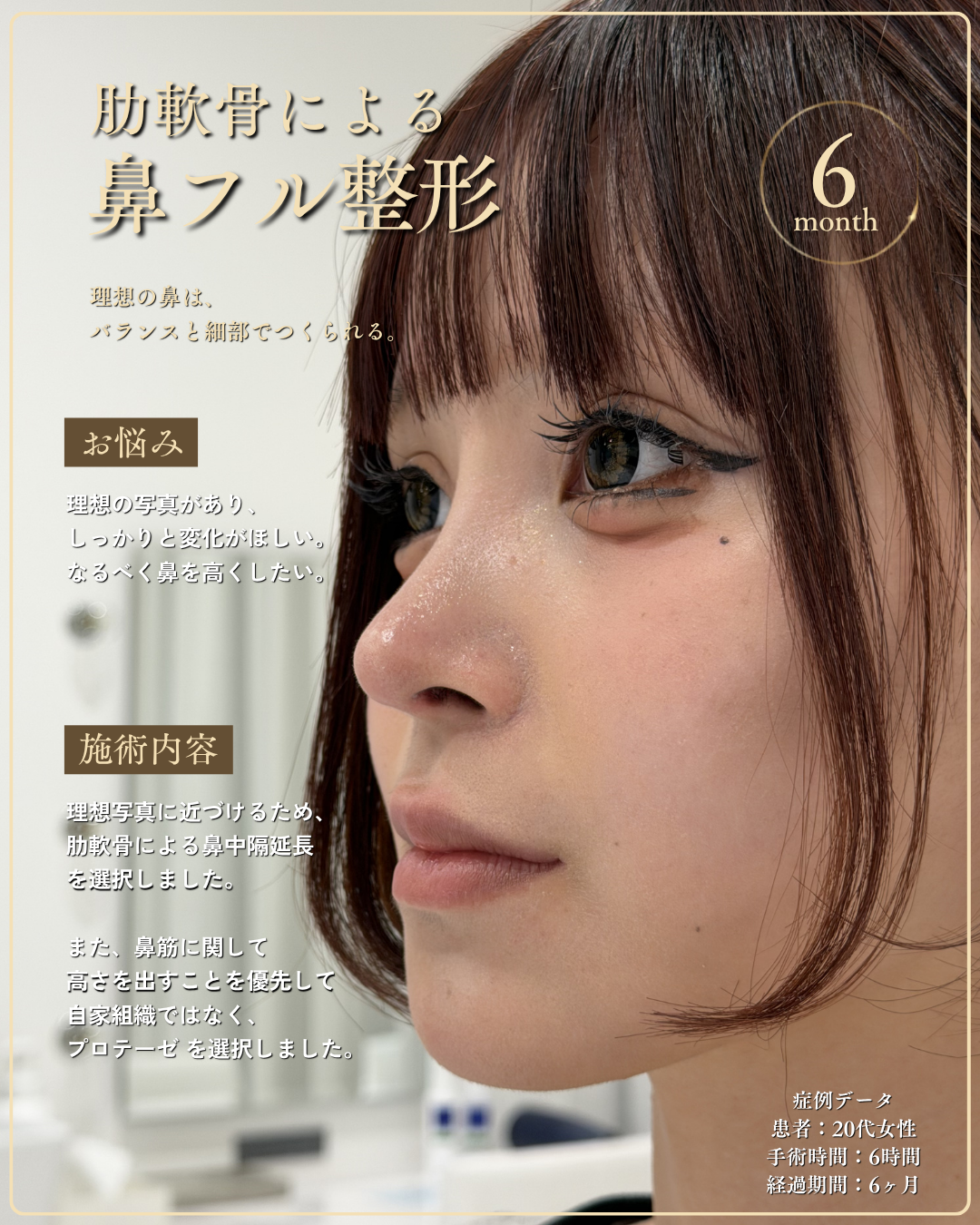
Main concernTo bring the tip and bridge closer to a reference photo, with a noticeable increase in height.
Why these procedures were chosenRib cartilage was selected to support the desired tip height in septal extension. A prosthesis was combined for the bridge, prioritizing the requested height.
- Procedures
- Septal extension (rib cartilage)/Tip plasty/Bridge augmentation (prosthesis)/Alar reduction/Paranasal augmentation (rib cartilage)/Columellar-base augmentation (rib cartilage)
- Fee
- 1,500,000 JPY (Tax included; self-pay treatment)
Anesthesia, tests and medication cost extra. Non-nasal procedures are excluded. - Main risks
- Swelling, bruising, infection, asymmetry, cartilage deformity, chest scarring or pain and, rarely, pneumothorax. Full risk information
View fee breakdown
Rib cartilage plan 1,100,000 JPY (septal extension, tip plasty and cartilage grafting included) + alar reduction 100,000 JPY + prosthesis 100,000 JPY + combined paranasal/columellar-base augmentation with rib cartilage 200,000 JPY
Case 2 | Improve nasal height and the profile
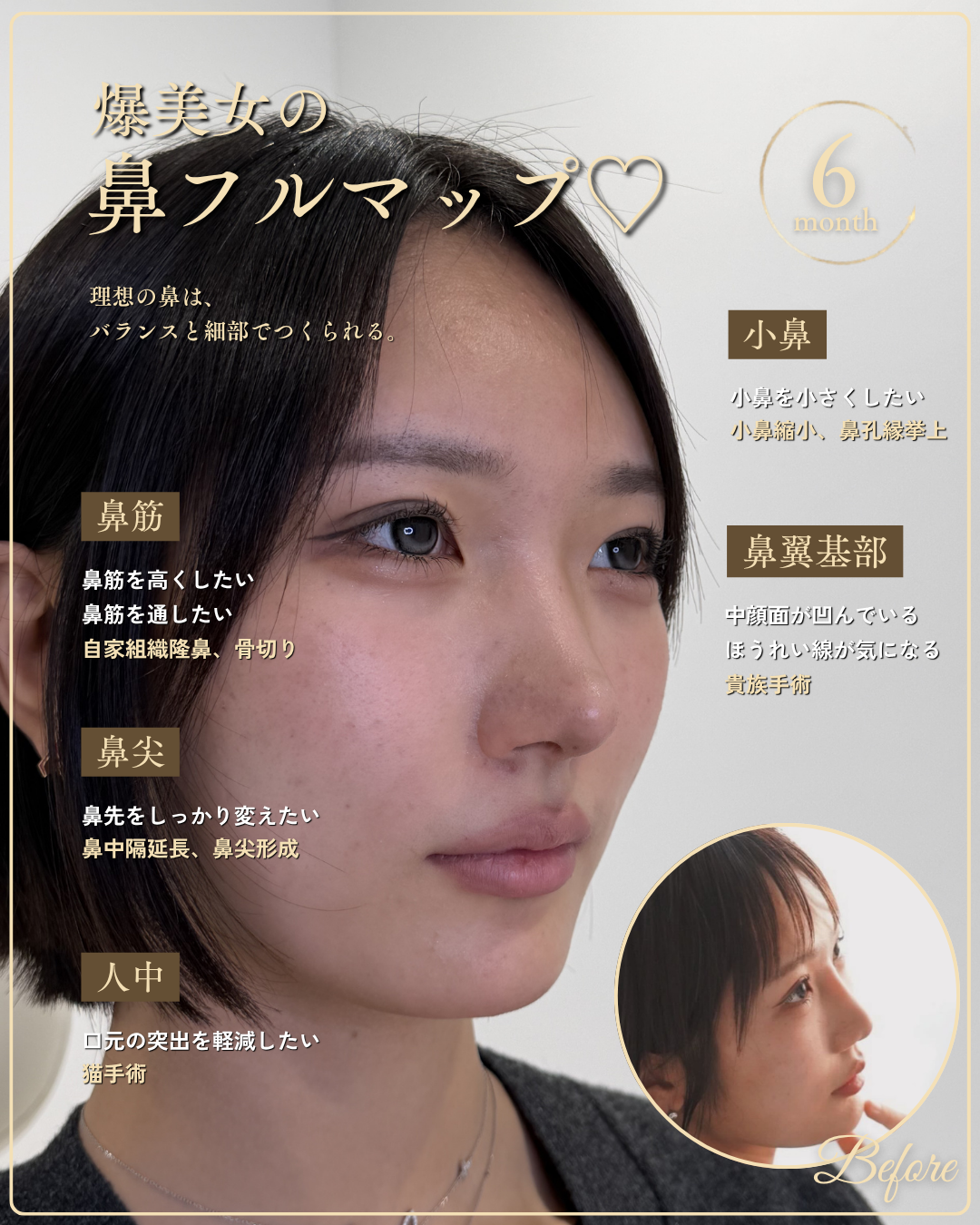
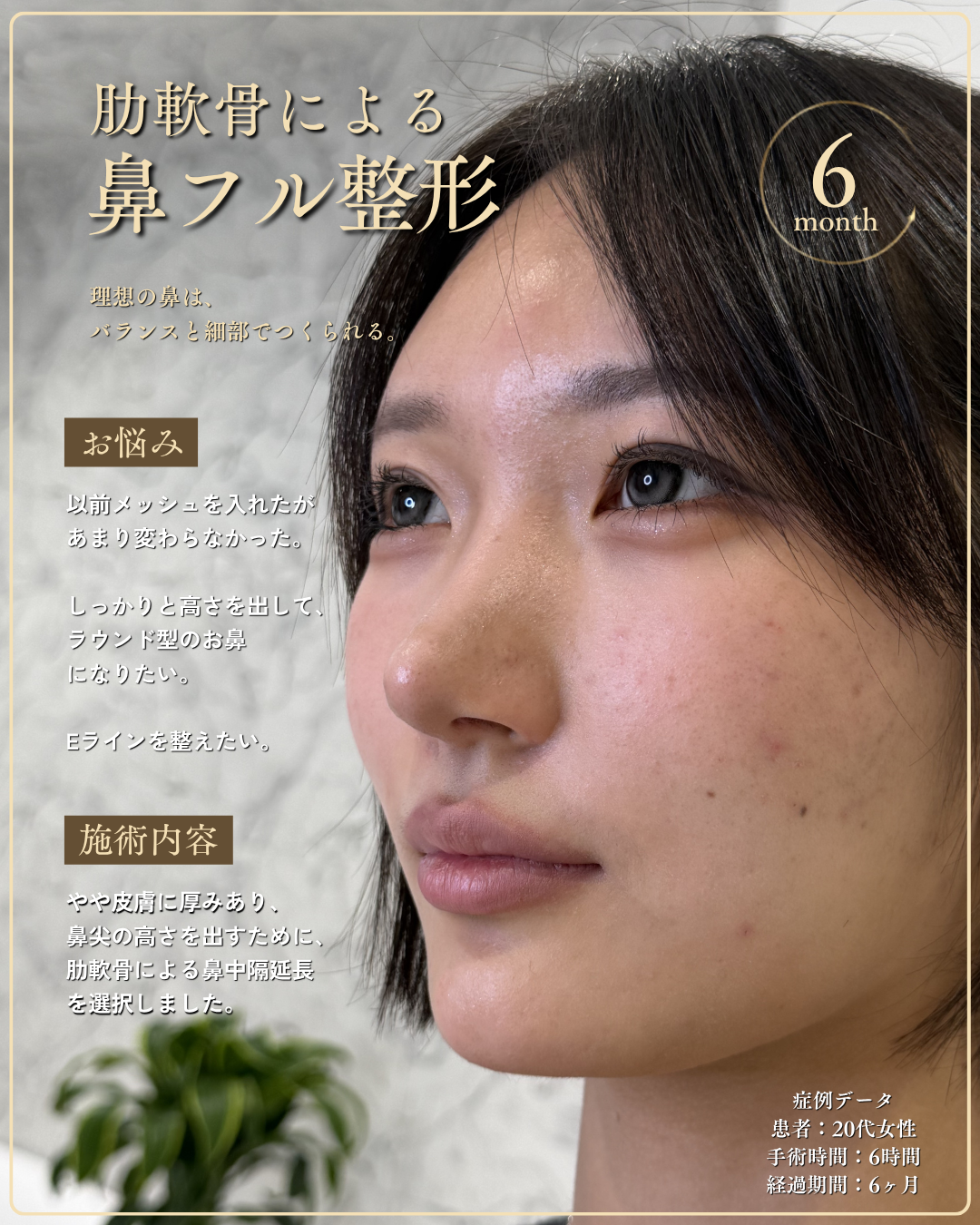
Main concernLittle change after an earlier mesh procedure; seeking more nasal height and a different profile.
Why these procedures were chosenSkin thickness was considered when selecting rib cartilage to support the desired tip height. Rib cartilage bridge augmentation, osteotomy and other procedures were combined.
- Procedures
- Septal extension (rib cartilage)/Tip plasty/Autologous bridge augmentation (rib cartilage)/Osteotomy/Alar reduction/Alar rim elevation/Paranasal augmentation (rib cartilage)/Columellar-base augmentation (rib cartilage)
- Fee
- 1,850,000 JPY (Tax included; self-pay treatment)
Anesthesia, tests and medication cost extra. Non-nasal procedures are excluded. - Main risks
- Swelling, bruising, infection, asymmetry, cartilage deformity, chest scarring or pain and, rarely, pneumothorax. Full risk information
View fee breakdown
Rib cartilage plan 1,100,000 JPY (septal extension, tip plasty and cartilage grafting included) + alar reduction 100,000 JPY + alar rim elevation 100,000 JPY + nasal osteotomy 150,000 JPY + combined paranasal/columellar-base augmentation with rib cartilage 200,000 JPY + autologous bridge augmentation 200,000 JPY
Case 3 | Balance the tip and mouth area


Main concernConcern about a round tip and the balance between the nasal base and mouth.
Why these procedures were chosenThe plan addressed both the tip and nasal base. Rib cartilage was used for septal extension and bridge augmentation.
- Procedures
- Septal extension (rib cartilage)/Tip plasty/Autologous bridge augmentation (rib cartilage)/Alar reduction/Paranasal augmentation (rib cartilage)/Columellar-base augmentation (rib cartilage)
- Fee
- 1,600,000 JPY (Tax included; self-pay treatment)
Anesthesia, tests and medication cost extra. Non-nasal procedures are excluded. - Main risks
- Swelling, bruising, infection, asymmetry, cartilage deformity, chest scarring or pain and, rarely, pneumothorax. Full risk information
View fee breakdown
Rib cartilage plan 1,100,000 JPY (septal extension, tip plasty and cartilage grafting included) + alar reduction 100,000 JPY + combined paranasal/columellar-base augmentation with rib cartilage 200,000 JPY + autologous bridge augmentation 200,000 JPY
Ear or rib cartilage: when is each considered?
Choose according to what your nose needs, rather than price alone.
Ear cartilage
When sufficient material
and support are available
Ear cartilage may be considered if it can achieve the planned change.
Donor-site effects: ear scarring, pain and other risks
Rib cartilage
When more material
or support is needed
Considered when ear cartilage is judged unlikely to meet the surgical goals.
Donor-site effects: chest scarring, pain and, rarely, pneumothorax
Three areas where rib cartilage can be used
- TipSupport height and direction with septal extension
- BridgeAdd height with autologous augmentation
- Nasal baseAugment the areas beside the nostril bases and beneath the columella
Skin thickness and previous surgery also matter. Not everyone needs all three procedures.
Two questions when comparing estimates
- What change could ear cartilage achieve for me?
- Why do you recommend rib cartilage in my case?
We explain our recommendation and its reasons, including when ear cartilage can meet your goals.
The material alone does not determine the result. Rib cartilage can warp, shift or resorb, and the desired outcome is not guaranteed. More about risks
Rib cartilage surgery is also available with the closed approach
Dr. Hane also performs rib cartilage rhinoplasty through incisions inside the nostrils.
Rib cartilage can sometimes be used without an incision across the columella. At Fukuoka Clinic, Dr. Hane uses the closed approach for rib cartilage septal extension and bridge augmentation.
The material and approach are chosen according to your goals and nasal anatomy. Prior surgery or the condition of your nose may lead to a different recommendation. The closed approach still leaves a chest donor-site scar and any incisions needed for additional procedures such as alar reduction.
Case 4 | Refine a round tip and overall nasal balance
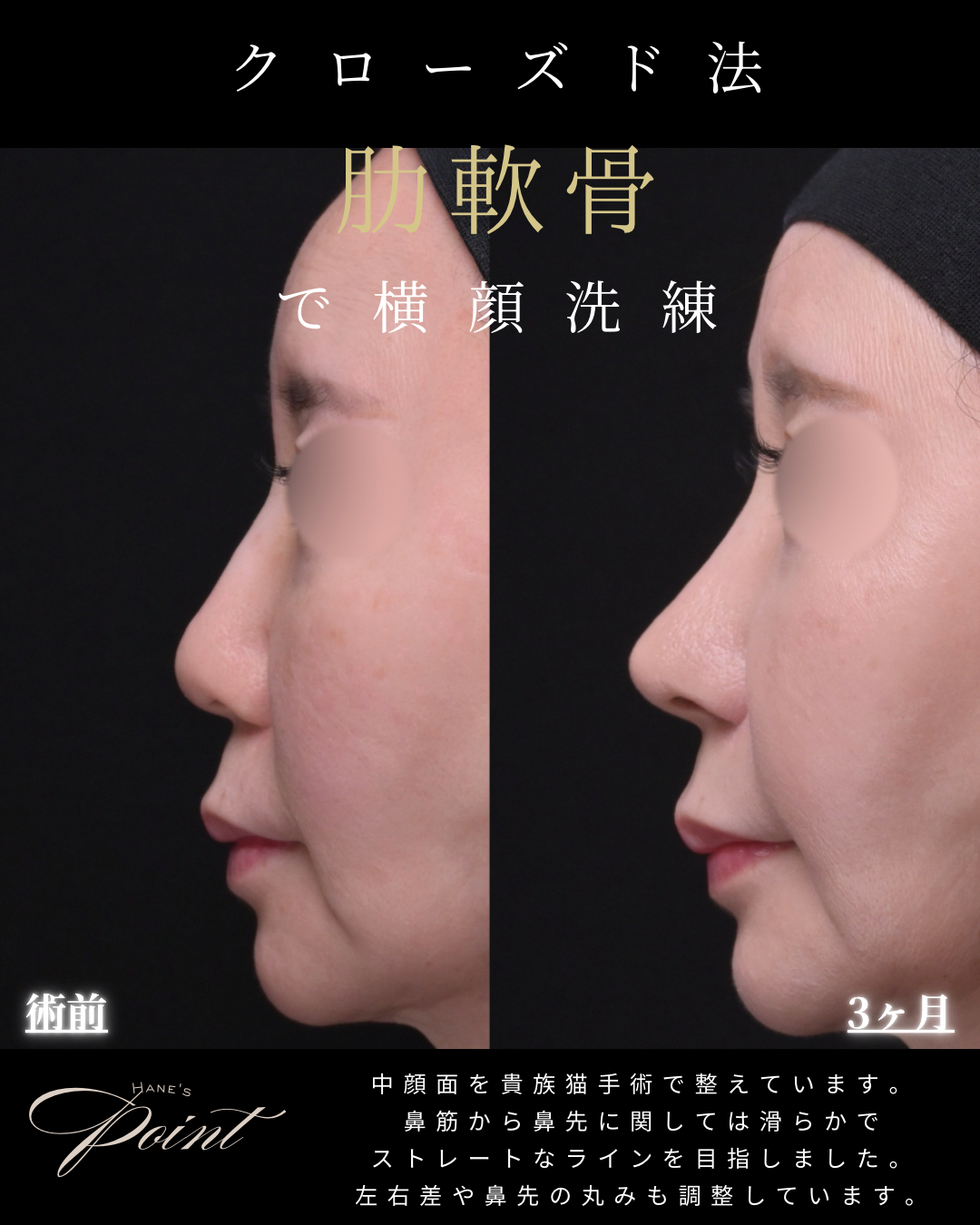
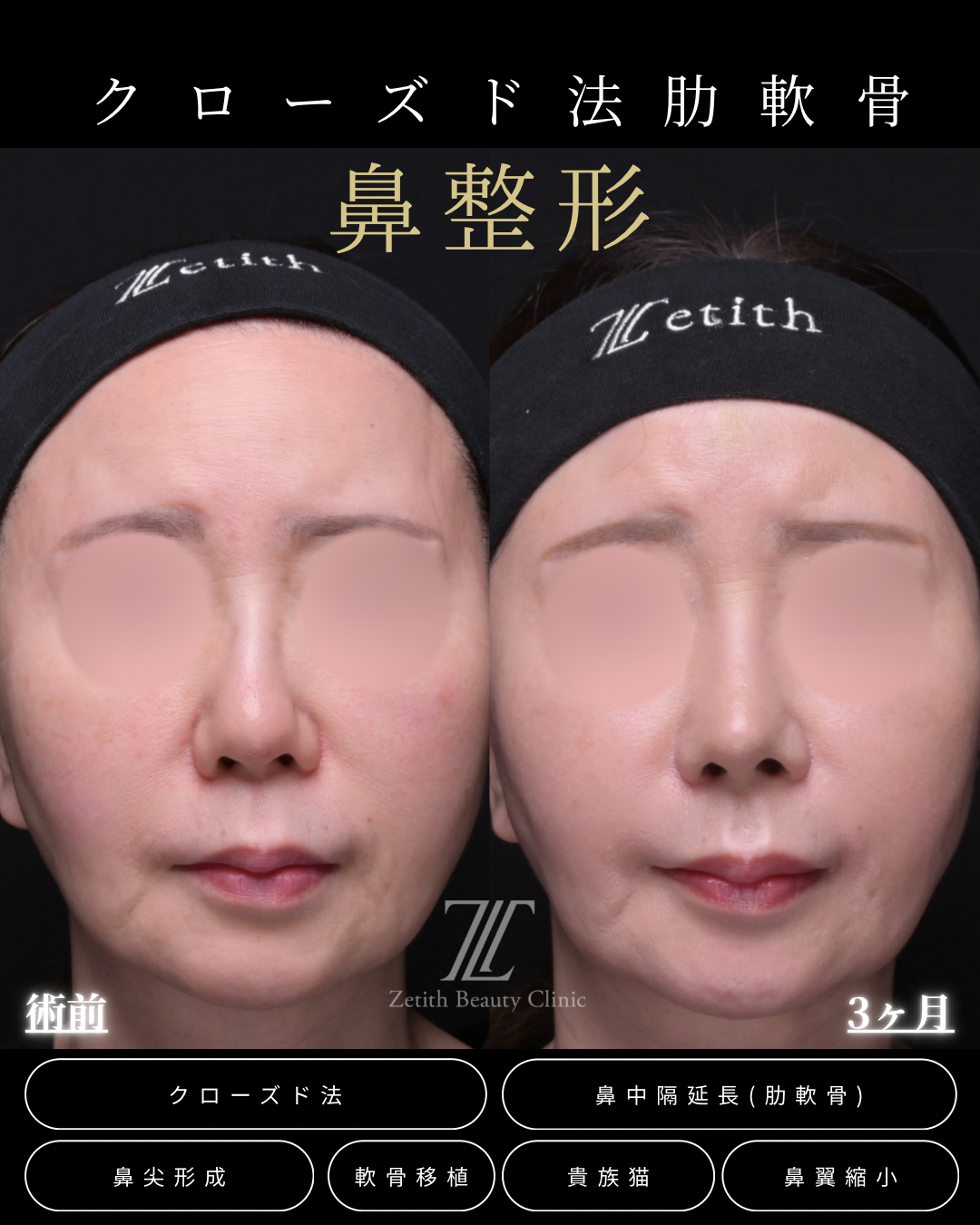
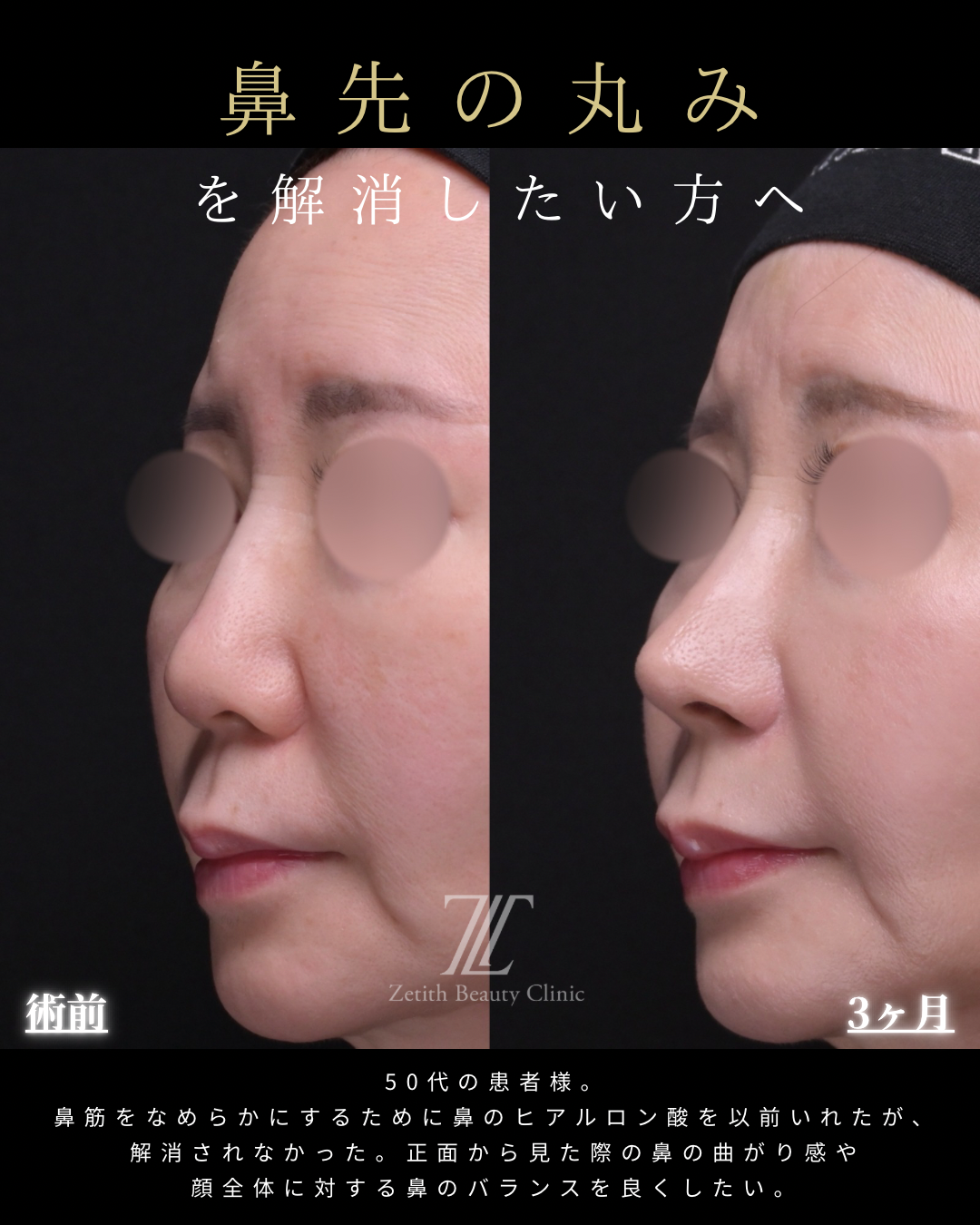
Main concernConcern about tip roundness and deviation from the front, with a wish for a nose balanced with the face.
Why these procedures were chosenRib cartilage supported the tip, combined with tip plasty, cartilage grafting, alar reduction, and paranasal and columellar-base augmentation.
- Procedures
- Septal extension (rib cartilage)/Tip plasty/Cartilage grafting/Alar reduction/Paranasal and columellar-base augmentation (rib cartilage)
- Fee
- 1,400,000 JPY (Tax included; self-pay treatment)
Anesthesia, tests and medication cost extra. Non-nasal procedures are excluded. - Main risks
- Swelling, bruising, infection, asymmetry, cartilage deformity, chest scarring or pain and, rarely, pneumothorax. Full risk information
View fee breakdown
Rib cartilage plan 1,100,000 JPY (septal extension, tip plasty and cartilage grafting included) + alar reduction 100,000 JPY + combined paranasal/columellar-base augmentation with rib cartilage 200,000 JPY
Chest scars and recovery
Consider the effects on your chest as well as changes to your nose.
- A chest scar remains. Its location, size and visibility depend on harvesting technique and individual healing.
- Both nose and chest may hurt. Nasal swelling and bruising, chest tightness and recovery time vary.
- Residual swelling and firmness change over months. Splinting, suture removal, and returning to work or exercise depend on the procedures and recovery.
If you have a planned event, tell us the date. Read more about recovery.
How much does it cost?
Additional procedures are added to the base rib cartilage plan.
Rib cartilage plan
1,100,000 JPY (tax included)
Includes septal extension, tip plasty and cartilage grafting
Additional procedures, when needed
Tax included. Self-pay treatment. Anesthesia, tests and medication cost extra.
Nasal procedure fees: case 1, 1,500,000 JPY; case 2, 1,850,000 JPY; case 3, 1,600,000 JPY; case 4, 1,400,000 JPY. Each case card includes a fee breakdown.
Extra costs: intravenous anesthesia 55,000 JPY or general anesthesia 209,000 JPY; preoperative tests 17,600 JPY; medication. Procedures outside the nose, such as eye surgery, are excluded. Monitor-program pricing or actual payments may differ. Confirm the current total in your individual estimate.
Risks to understand before surgery
Using your own cartilage does not eliminate complications.
- Nose: swelling, bruising, pain, infection and asymmetry; cartilage warping, shifting or resorption, tip stiffness, relapse and nasal obstruction.
- Chest: scarring, pain, altered sensation, indentation or deformity, hematoma and infection; rarely, pneumothorax.
- Outcome: the result may differ from your goals, and revision surgery may be needed.
Risks depend on your health and combined procedures. Discuss those relevant to you during examination. Contact medical care promptly for shortness of breath, severe chest pain, fever or rapidly worsening swelling or pain. Sudden breathing difficulty requires emergency care.
Questions before a consultation
Will rib cartilage make my nose look unnatural?
The material alone does not determine naturalness. Planning considers your nose, facial features, and desired height and direction. Avoiding excessive height or length also matters.
Do I need rib cartilage rather than ear cartilage?
Ear cartilage can meet some patients’ goals. We examine the support and amount needed, skin and previous surgery. If rib cartilage is recommended, we explain why and what ear cartilage could achieve in your case.
Can I bring a photo of my ideal nose?
Yes. It helps clarify your preferences and concerns. Different anatomy and skin mean we cannot promise the same result as the photo.
Will there be a visible incision on my nose?
The closed approach does not cut across the columella. Combined procedures such as alar reduction have their own incisions. A chest donor-site scar also remains.
References
American Society of Plastic Surgeons: rhinoplasty risks and safety (general rhinoplasty information)
أسئلة يمكنك طرحها بعد ذلك على الذكاء الاصطناعي
Let’s start with the nose you have in mind.
Bring reference photos if you have them. You do not need to explain everything perfectly. We will discuss what is possible, the limitations, scars and costs alongside your concerns.
These are self-pay procedures, not covered by Japanese health insurance. Cases involve combined operations; results and recovery vary. Outcomes are not guaranteed.